

Losing a tooth — whether due to decay, injury, or gum disease — is more than just a cosmetic concern. It affects how you chew, how you speak, and even how your jawbone maintains its shape over time. The good news is that modern dentistry offers several highly effective tooth replacement solutions, each with its own unique set of advantages. At 1 OAK Dentistry, we help patients throughout Southwest Florida navigate these choices with clarity and confidence, so they can make the decision that best fits their lifestyle, health, and long-term goals.
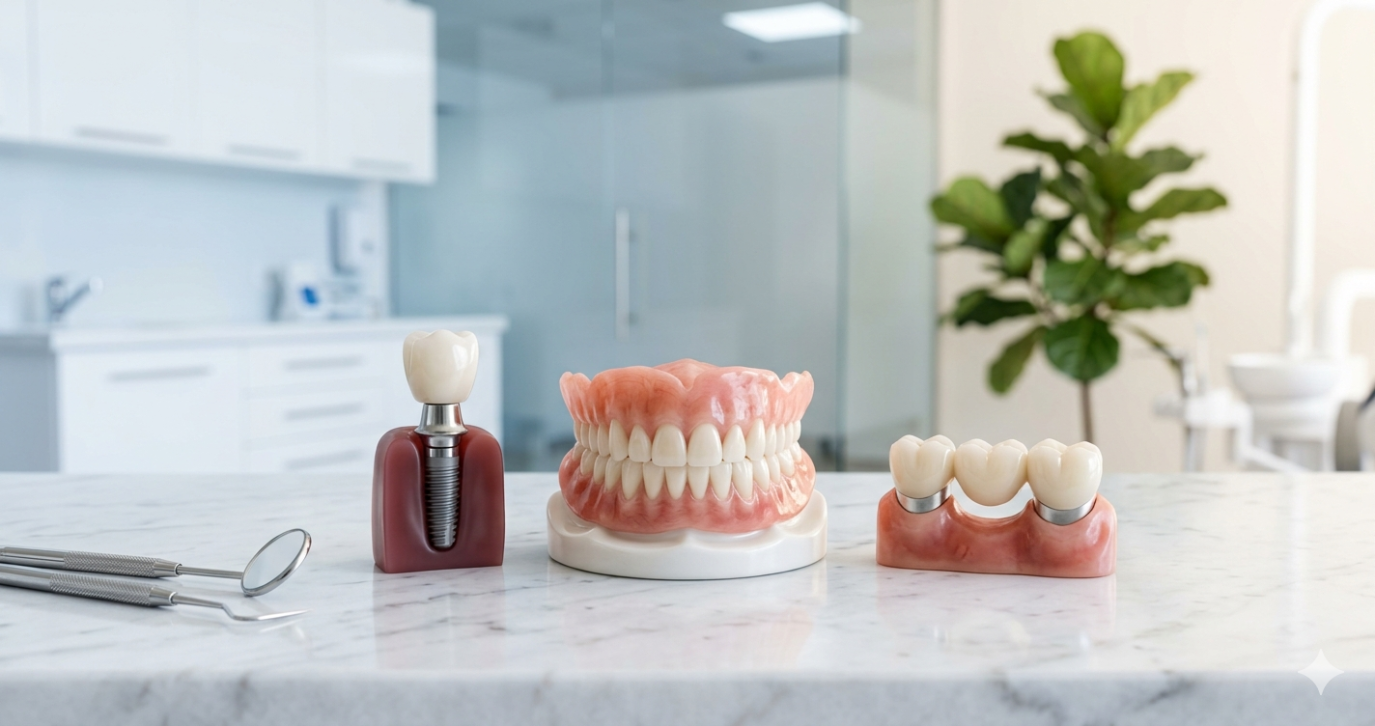
The three most common options for replacing missing teeth are dental implants, dentures, and dental bridges. Understanding how each works — and what each demands of you as a patient — is the first step toward reclaiming a healthy, complete smile.
Dental Implants: The Gold Standard in Tooth Replacement
Dental implants are widely regarded as the most advanced and durable solution for missing teeth. An implant consists of a small titanium post that is surgically placed into the jawbone, where it fuses with the bone over time through a process called osseointegration. Once fully integrated, a custom-crafted crown is placed on top, creating a replacement tooth that looks, feels, and functions virtually identically to a natural one.
Why Implants Stand Apart
One of the greatest advantages of dental implants is that they preserve jawbone density. When a tooth is lost, the bone beneath it begins to deteriorate because it no longer receives the stimulation provided by a tooth root. Implants replicate that stimulation, preventing bone loss and helping to maintain your facial structure over time. This is something neither dentures nor bridges can offer.
Implants are also a permanent solution. With proper care and regular dental checkups, they can last decades — in many cases, a lifetime. They do not require adhesives, they do not slip, and they do not require the alteration of neighboring healthy teeth.
Who Is a Good Candidate for Implants?
Ideal candidates for dental implants are patients who have sufficient jawbone density to support the titanium post, healthy gum tissue, and no uncontrolled systemic conditions that could impair healing. Patients who have experienced bone loss may still be candidates with the help of a bone grafting procedure. During your consultation at 1 OAK Dentistry, Dr. Marc Dadkhah will evaluate your oral and overall health to determine whether implants are the right fit for you.
Dentures: A Removable, Flexible Solution
Dentures have come a long way from the ill-fitting, uncomfortable appliances of the past. Today's dentures are crafted from high-quality materials and customized to fit the contours of your mouth with far greater precision and aesthetics than earlier versions. They remain one of the most widely used tooth replacement options, particularly for patients who need to replace multiple or all of their teeth.
Full vs. Partial Dentures
Full dentures replace an entire arch of teeth — either the upper, lower, or both — and rest on the gum tissue. Partial dentures, on the other hand, are used when some natural teeth remain. They attach to those remaining teeth using metal clasps or precision attachments and fill in the gaps left by missing teeth.
The Benefits and Limitations of Dentures
Dentures are a more affordable upfront option compared to implants, and they can be fabricated relatively quickly. They are also non-surgical, making them accessible to patients who may not be good surgical candidates due to age or health concerns.
However, dentures do have limitations. They can shift or slip while eating or speaking, may require adhesives for stability, and typically need to be replaced every five to seven years as the shape of your gums and jawbone changes. Because they sit on top of the gum rather than integrating with the bone, they do not prevent bone loss over time.
For patients who want the stability of dentures with the bone-preserving benefits of implants, implant-supported dentures offer an excellent middle ground — anchoring a full arch of teeth to a small number of strategically placed implants for a secure, confident fit.
Dental Bridges: A Fixed Solution Without Surgery
A dental bridge is a fixed prosthetic that literally bridges the gap created by one or more missing teeth. It consists of one or more artificial teeth — called pontics — held in place by crowns that are cemented onto the natural teeth on either side of the gap. These supporting teeth are called abutment teeth.
When a Bridge Makes Sense
Bridges are an excellent option for patients who are missing one or a few consecutive teeth, have healthy teeth adjacent to the gap, and prefer a fixed solution that does not involve surgery. Unlike implants, bridges do not require osseointegration time, meaning they can often be completed in just a few appointments and are ready to function fully within a couple of weeks.
Considerations for Bridges
The main trade-off with a traditional bridge is that the healthy abutment teeth must be filed down to accommodate the crowns. This permanently alters those teeth and may make them more susceptible to decay or sensitivity over time. Like dentures, bridges also do not stimulate the jawbone beneath the missing tooth, so some degree of bone loss can occur in that area.
That said, a well-crafted bridge can last ten to fifteen years or longer with proper care, and it provides a stable, natural-looking result that many patients are extremely happy with.
Comparing Your Options at a Glance
- Dental Implants: Most durable and natural-feeling; preserves bone; requires surgery; highest upfront investment; can last a lifetime
- Full or Partial Dentures: Non-surgical; most affordable upfront; removable; may require adhesives; does not preserve bone; needs periodic replacement
- Dental Bridges: Fixed and stable; no surgery required; alters adjacent teeth; does not preserve bone; typically lasts ten to fifteen or more years
- Implant-Supported Dentures: Combines stability of implants with coverage of dentures; excellent for full arch replacement; requires surgery but fewer implants than individual replacements
How to Make the Right Choice for Your Smile
There is no single answer that applies to every patient. The right tooth replacement option depends on a variety of highly personal factors, including the number of missing teeth, the health of your jawbone and gums, your budget, your medical history, and your long-term expectations. A patient who is young, healthy, and missing a single tooth may find that an implant is clearly the best long-term investment. An older patient who has lost all of their teeth and prefers a non-surgical approach may be very well served by a high-quality full denture or an implant-retained overdenture.
At 1 OAK Dentistry, Dr. Marc Dadkhah takes the time to understand each patient's unique situation before making any recommendation. We believe that great dentistry is never one-size-fits-all. It requires listening, evaluating, and collaborating with patients to find solutions that balance function, longevity, and the kind of aesthetic result that makes people want to smile.
If you are living with one or more missing teeth and are ready to explore your options, we encourage you to schedule a consultation with our team. Whether you ultimately choose an implant, a bridge, or a denture, taking action to replace a missing tooth is one of the most important investments you can make in your oral health — and in your quality of life. We are proud to serve patients across Southwest Florida and look forward to helping you find the smile you deserve.

