

Introduction
When most people think about oral health, they focus on teeth, gums, and maybe even breath. But what many don’t realize is that your mouth is closely connected to systems that affect balance, stability, and spatial awareness.
At 1 Oak Dentistry, we often emphasize that oral health is never isolated — it connects to the body in ways that can be surprising. One of the lesser-known connections is the relationship between your bite, jaw alignment, and your body’s sense of balance.
How Your Jaw Connects to Your Balance System
Your jaw doesn’t operate independently. It is part of a complex network involving muscles, nerves, and joints that communicate with your head, neck, and inner ear.
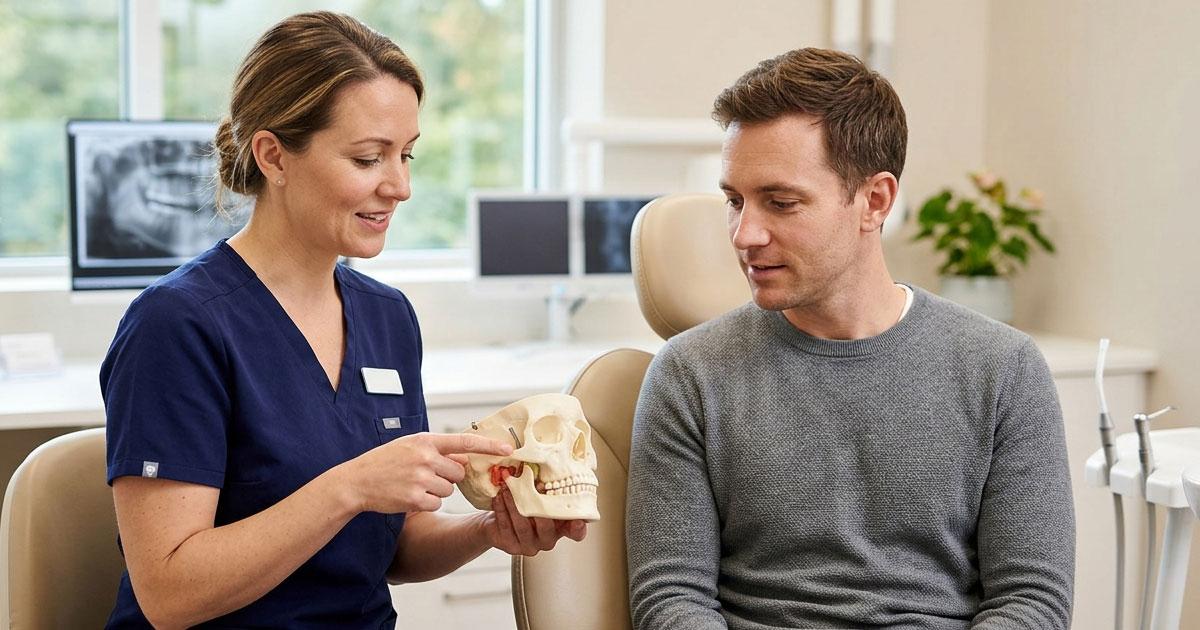
The temporomandibular joint (TMJ), which connects your jaw to your skull, sits very close to structures involved in balance. When the bite is misaligned or the jaw is under strain, it can create tension patterns that affect nearby muscles and nerves.
This can sometimes contribute to symptoms such as:
- Mild dizziness or lightheaded sensations
- A feeling of imbalance when moving the head
- Neck or facial tension that radiates into the head
- Fatigue in the jaw after chewing or talking
The Role of Bite Alignment
Your bite is more than just how your teeth come together — it influences how force is distributed through your jaw and skull.
When the bite is properly aligned, pressure is balanced evenly. But when it’s off, even slightly, your body may compensate in subtle ways:
- Overworking certain jaw muscles
- Shifting head posture unconsciously
- Increasing tension in the neck and upper back
- Creating uneven sensory feedback to the brain
Over time, these small imbalances can contribute to discomfort that extends beyond the mouth.
The Inner Ear Connection
Your inner ear plays a major role in balance and spatial orientation. It communicates constantly with your brain to help you stay steady and oriented in space.
Because the jaw, skull, and inner ear are anatomically close, inflammation or tension in the jaw area can sometimes influence how this system feels and functions.
While dental issues are not the sole cause of dizziness, they can be one contributing factor in a larger pattern that includes posture, stress, and muscle tension.
Signs Your Oral Health May Be Affecting Balance
Not all balance issues are dental-related, but there are some patterns worth paying attention to:
- Jaw clicking, popping, or tightness
- Frequent clenching or grinding (especially during sleep)
- Headaches that start near the temples or jaw
- Neck stiffness that doesn’t improve with stretching
- Dizziness that appears alongside jaw discomfort
These symptoms don’t automatically point to a dental cause, but they can signal a connection worth evaluating.
Why Dental Evaluation Matters
At 1 Oak Dentistry, we look beyond isolated symptoms. When patients experience unexplained tension, headaches, or discomfort that overlaps with jaw function, a full evaluation can help identify whether bite alignment or TMJ stress is contributing.
Modern dental assessments can help detect:
- Bite imbalance
- Signs of grinding or clenching
- TMJ inflammation or strain
- Uneven wear patterns on teeth
Addressing these issues early can help reduce strain and improve overall comfort.
Closing Thoughts
Your oral health is part of a much larger system that includes muscles, nerves, posture, and even balance. While not every dizziness or stability issue is dental-related, the connection between your bite and your body’s alignment is real and often overlooked.
Understanding this relationship is another step toward seeing oral health the way we do at 1 Oak Dentistry — as an essential part of whole-body wellness, not just a smile.

