
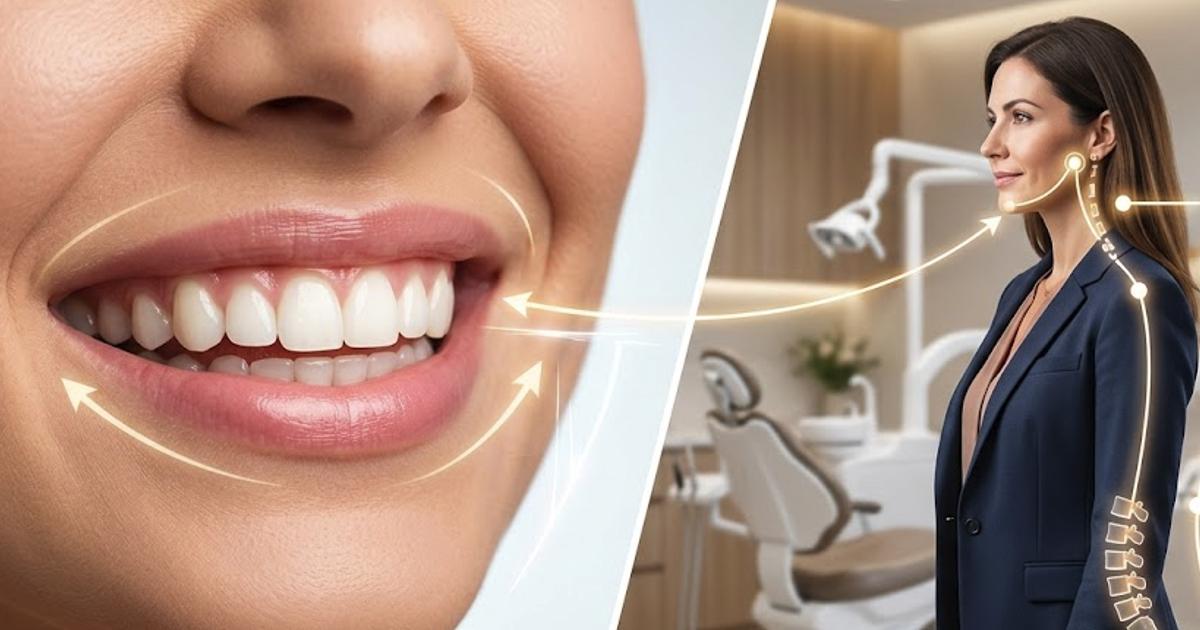

When most people think about posture, they think about the spine, shoulders, and core muscles. But one of the most overlooked influences on posture is actually the position and balance of your jaw. Your bite plays a much larger role in full-body alignment than most patients realize.
At 1 Oak Dentistry, we often see how subtle dental imbalances can contribute to tension patterns that extend far beyond the mouth—affecting the neck, shoulders, and overall posture over time.
How Your Bite Influences Head and Neck Position
Your jaw is directly connected to your skull and supported by a complex system of muscles that extend into your neck and upper back. When the bite is properly aligned, these muscles work in balance. When it’s not, your body often compensates in ways you don’t immediately notice.
Common postural effects of bite imbalance include:
- Forward head posture
- Neck stiffness or tightness
- Shoulder asymmetry
- Jaw tension during daily activities
- Uneven muscle strain along the upper back
These patterns often develop gradually, making them easy to overlook until discomfort becomes persistent.
The Jaw-Muscle Chain Reaction
Your temporomandibular joint (TMJ) is one of the most active joints in the body. When it is under strain due to clenching, grinding, or misalignment, it can trigger a chain reaction through connected muscle groups.
This can lead to:
- Chronic jaw fatigue
- Tension headaches
- Neck and shoulder discomfort
- Difficulty maintaining relaxed posture
- Increased strain during sleep or stress
Because these systems are interconnected, even small imbalances can influence how your entire upper body feels and functions.
How Poor Posture Can Also Affect Your Bite
The relationship between posture and oral health is not one-directional. Just as the bite can affect posture, posture can also influence how your jaw functions.
For example:
- Slouching can shift jaw alignment
- Forward head posture can increase bite pressure
- Muscle fatigue can lead to clenching or grinding
- Uneven spinal alignment can affect TMJ balance
This creates a feedback loop where posture and oral health continuously influence each other.
Signs Your Bite May Be Affecting Your Posture
Many patients are surprised to learn that dental alignment may be contributing to discomfort they experience daily. Some common signs include:
- Frequent neck or shoulder tension without clear cause
- Jaw soreness upon waking
- Clicking or popping in the jaw joint
- Headaches that seem to originate from the neck
- Difficulty finding a comfortable resting jaw position
If these symptoms persist, a dental evaluation may help identify whether bite alignment is part of the issue.
Why a Whole-Body Approach Matters
Modern dentistry recognizes that oral health is closely connected to overall wellness. Evaluating bite alignment is not just about teeth—it’s about understanding how the entire head, neck, and muscle system works together.
At 1 Oak Dentistry, this whole-body perspective helps patients:
- Identify hidden sources of discomfort
- Improve jaw function and comfort
- Reduce unnecessary muscle strain
- Support better long-term oral health outcomes
Final Thought
Your posture is more than just how you stand—it’s a reflection of how your body is working together. When the bite is balanced, the surrounding muscles can function more naturally. When it’s not, the effects can extend far beyond the mouth.
Understanding this connection is an important step toward both better oral health and better overall comfort in daily life.

